Why every generator connection needs a transfer device
When the power goes out, the utility lines in front of your house are still connected to the transformer on the pole. If a generator is connected to your house wiring without a way to disconnect from the grid first, the generator's power can flow backward out of your house, through the transformer and onto the lines. That's called backfeeding. It can electrocute line workers who think the lines are dead, damage your generator when utility power comes back, and start fires.
The fix is a transfer device: a switch or interlock that makes it physically impossible to have your house connected to the utility and the generator at the same time. Every safe generator connection uses one, and the electrical code requires it.
Eastern NC Generators connects homeowners with a licensed North Carolina electrical contractor who installs all three common types: automatic transfer switches, manual transfer switches and interlock kits.
Automatic transfer switches
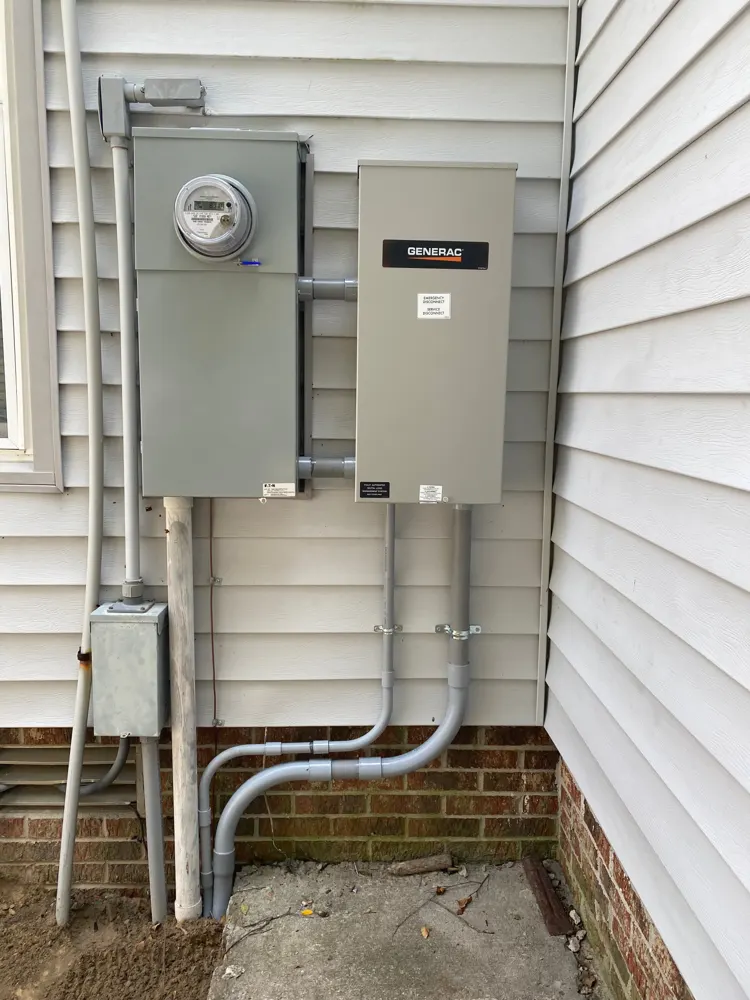
An automatic transfer switch (ATS) is part of every home standby generator system. It monitors utility power around the clock. When power fails, it signals the generator to start, then moves your house from the utility to the generator. When utility power returns and holds steady, it moves the house back and lets the generator cool down and shut off.
There are two main setups:
- Service-rated whole-house switches are installed where power enters the house, often next to or in place of the main breaker. The entire house can run on the generator, usually with load management to keep large appliances from overloading it.
- Essential-circuit switches feed a small separate panel holding only the circuits you choose: refrigerator, well pump, furnace, some lights and outlets. They pair with smaller generators.
If you're getting a whole house or standby generator, the transfer switch is included in the job.
Manual transfer switches for portable generators
A manual transfer switch lets you run selected circuits from a portable generator. The electrician installs a small panel next to your main panel, moves the chosen circuits onto it, and installs a power inlet box on the outside of the house. During an outage you set the portable outside at a safe distance, plug a generator cord into the inlet, start the generator and flip each circuit from "line" to "generator."
It's a solid, simple option when you want to power a handful of circuits and already own a portable generator.
Generator interlock kits
An interlock kit is a mechanical plate installed on your existing electrical panel. It slides so that the main breaker and a dedicated generator breaker can never be on at the same time. To use the generator, you turn off the main breaker, slide the interlock, and turn on the generator breaker. Then you turn on the circuits you want, staying within the generator's capacity.
Interlock kits are often the most affordable way to connect a portable generator, and they let you choose any circuit in the panel instead of a fixed list. They need a panel the interlock is made for, with space for the generator breaker, plus an inlet box on the outside wall. The installer checks whether your panel can accept one.
Which option fits your house
| Option | Works with | How it switches | Best for |
|---|---|---|---|
| Automatic transfer switch | Standby generator | Automatically, in seconds | Hands-off backup for the whole house or essential circuits |
| Manual transfer switch | Portable generator | You flip selected circuits | A fixed set of essential circuits, simple to use |
| Interlock kit | Portable generator | You switch the main and generator breakers | Lowest cost, flexible choice of circuits |
What never to do
Some people connect a portable generator by plugging a cord with two male ends into a dryer or range outlet. This is sometimes called a "suicide cord," and the name is accurate. It backfeeds the house with no protection for line workers, leaves the plug prongs live and exposed, and can overload your wiring. It is illegal and dangerous. If you have a portable generator, an inlet box with a transfer switch or interlock is the safe way to use it.
How installation works
For a manual transfer switch or interlock kit, the work usually takes part of a day: a visit to check the panel and pick an inlet location, the permit, the installation, and the inspection. For an automatic transfer switch, it's part of a full standby generator installation:
How installation works
Site visit
An installer walks the property, looks at your electrical panel and gas or propane setup, and picks a spot for the unit that meets clearance and flood rules.
Sizing
You decide what should run during an outage, from a few essential circuits to the whole house. That choice sets the generator size and the transfer switch.
Permit
The contractor pulls the electrical permit, and a gas or plumbing permit where needed, from the city or county that covers your address.
Gas line or propane tank
Natural gas homes may need a meter upgrade from the gas company. Propane homes get a tank sized for multi-day run time and a line to the unit.
Installation
The pad is set, the generator is placed and the transfer switch is wired into your panel. Most residential installs take one to two days on site.
Inspection and startup
The local inspector signs off, the unit is started and tested under load, and you are shown how it exercises itself and how to check it.
Sizing your portable for the circuits you choose
Your portable generator's running watts limit what you can power at once. The installer can help you pick circuits that fit: typically the refrigerator, a freezer, some lights, the furnace blower, a few outlets, and the well pump if the generator is large enough. Central air conditioners are usually beyond what a portable can start.
Areas we cover
Transfer switch and interlock kit installation is available across eastern North Carolina, including Kinston, Goldsboro, Rocky Mount, Washington, Havelock, Greenville, New Bern, Jacksonville, and Wilson. See the full service area.
Common questions
Do I need a transfer switch for a portable generator?
If you want to power any of your home's hard-wired circuits, yes: a transfer switch or an interlock kit. Running extension cords directly from the generator to appliances doesn't need one, but anything connected to your panel does.
Is an interlock kit legal in North Carolina?
Interlock kits that are listed for your specific panel and installed with a permit and inspection are an accepted way to connect a generator. The installer confirms the right kit for your panel.
What's the difference between a transfer switch and an interlock kit?
A manual transfer switch moves a fixed set of circuits to the generator through a separate small panel. An interlock kit works on your existing panel and lets you choose any circuits, as long as you stay within the generator's capacity.
Can I install an interlock kit myself?
The work is inside your main electrical panel and needs a permit and inspection. It should be done by a licensed electrician.
Can a transfer switch be added to an existing standby generator?
Every standby generator already has one. If yours was installed with an essential-circuit switch and you want more coverage, the installer can look at upgrading the switch and whether the generator can handle the extra load.
How do I connect a portable generator to my house?
Through an inlet box wired to a manual transfer switch or interlock kit, installed by a licensed electrician. Never use a double-male cord plugged into an outlet.